




The employee benefits and perks offered by an employer can play a big role in deciding whether a job feels like the right fit. Following our previous benefits report in 2023, we’ve carried out the research again to explore how priorities have changed and which perks candidates value most in today’s job market.
We analysed responses from more than 3,000 candidates. Here, we highlight some of the key insights from our survey. For the full findings exploring employee benefits and perks, download the CharityJob Benefits Report 2026.
Benefits candidates received in their current role

The most commonly received benefit among charity sector candidates was 25+ days annual leave, with more than three quarters of respondents saying they receive it in their current role. This was also the most commonly received benefit among candidates outside the charity sector, although at a lower rate of 66%.
Flexibility of working hours/location was the second most commonly received benefit by charity sector employees, selected by 70%, followed by remote working options at 64%.
Compared to candidates working outside the charity sector, those employed within the sector were more likely to receive each of the top six most common benefits and perks.
Benefits most desired by candidates
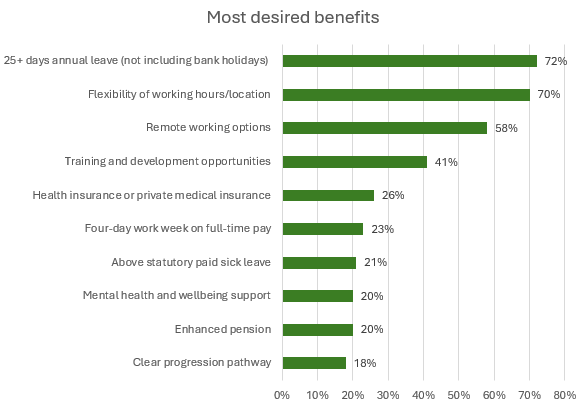
We also asked candidates to select up to five benefits and perks that matter most to them when looking for a new role. Interestingly, the top three most desired employee benefits were also the top three benefits candidates were receiving. Alongside annual leave and flexibility benefits, training and development opportunities ranked next with 41% of respondents selecting this as a priority. Health insurance or private medical insurance was also important for many candidates, chosen by just over a quarter of respondents.
The findings highlight that flexibility and career development opportunities remain key priorities for candidates when considering new roles.
Important factors when considering job opportunities

Candidates were asked to rate how important different factors were when considering job opportunities. We saw that all factors were considered at least ‘slightly important’ to the majority of candidates. Salary and organisation culture stood out as especially important, with more than half of candidates rating both as ‘very important’.
Looking at the combined ‘very important’ and ‘important’ figures, salary ranked highest overall at 91%, followed closely by flexibility of working hours/location, and organisation culture, both at 88%.
One of the biggest shifts since 2023 was the importance of flexibility. Half of respondents rated flexibility of working hours/location as ‘very important’, up from 38% in 2023. This highlights the increasing demand for better work life balance and more adaptable ways of working.
Types of flexible working

All respondents were asked to select their top three most important types of flexible working. Remote or hybrid working flexibility ranked highest, selected by 71% of respondents. Since the COVID-19 pandemic, hybrid and remote working have become increasingly common, and candidates continue to place high value on the ability to work outside of a traditional office environment. Flexitime followed closely behind at 69% and a compressed work week was selected by 38% of respondents.
Across all three options, more candidates rated these employee benefits as important than reported actually receiving them from their current employer, suggesting there is still a gap between candidate expectations and what organisations actually offer.
Final comments from candidates
At the end of the survey, we invited candidates to share any additional thoughts they had on employee benefits.
Many respondents highlighted the importance of working in a values-driven organisation with a positive and respectful culture. One respondent commented that “respect for others and cooperation are by far more important than salary”. Candidates also emphasised the importance of clearly communicating benefits so employees fully understand what’s available to them and can make the most of it.
Several comments also reflected the value of inclusive policies and support for employees with disabilities, reinforcing the importance of creating workplaces where people feel supported and able to thrive.
Want to find out more?
To learn more about the employee benefits candidates currently receive and what they prioritise when considering a new role, download the full CharityJob Benefits Report 2026.


